
Meta Is Using AI for Performance Reviews. Here Is Why That Is Both a Genius Move and a Terrible Idea
A clear, no-jargon glossary explaining essential AI concepts for teams, founders, and operators.
Few tasks in corporate life generate as much quiet dread as the performance review. The bureaucracy, the form filling, the endless checklists, all of it tends to feel like a ritual that gets in the way of actual progress. Whenever a new tool promises to automate that weight, most people feel a moment of relief. Meta is now encouraging its employees to use an internal AI chatbot, Metamate, for this exact purpose, which is to help draft year-end performance reviews.
This brings up an important question for the future of work. Is using AI for one of the most human responsibilities in business a clever productivity shortcut that removes friction, or is it a risky move that hands a core leadership function to a machine?
AI Is a Perfect Solution for a Problem We Should Be Careful About Solving
Here is the core paradox. AI is extremely good at cleaning up the administrative mess around performance reviews, yet the idea of handing a deeply human process to a chatbot still feels a little strange.
On one hand, the frustration with bureaucracy is real. The grind of completing forms and navigating formal processes often distracts from the work that matters. On the other hand, a company’s people are its most important asset. What moves a business forward is not what is written on a template. It is how motivated employees feel, how aligned they are with their goals, and the quality of the conversations they have with their managers. These parts of the process are subtle and hard to measure, which is why outsourcing them feels uncomfortable.
There is an old truth that still applies. What gets written down matters, but what never gets written down often matters more.
This Is Not Theory. It Is Already Happening, and the Results Are Uneven
This shift from interesting debate to actual implementation is already underway at Meta, and the first wave of feedback reveals a noticeable gap between the promise and the reality.
Meta employees are actively using Metamate to pull together summaries of their accomplishments for year-end reviews. Joseph Spisak, a product director at the company, has said the tool is helpful at searching through an employee’s documents and summarizing their work.
The experience from inside the company is a bit more layered. One anonymous employee reported that the results are sometimes inconsistent. The issue is a lack of detailed context about the work itself. This is the familiar context problem. A machine can summarize a task, but it cannot understand the office politics behind it. It does not know when a small accomplishment required months of patience or careful diplomacy. It does not recognize when progress involved emotional labor instead of technical execution. The tool can produce a solid template, but it cannot interpret the subtleties that define human contribution.
The Golden Rule: Remove Bureaucracy, Not Humanity
The essential distinction is between using AI as a helpful assistant and relying on it as a substitute for human leadership. The goal is to reduce the administrative friction, not the human presence and judgment that make feedback meaningful.
To make this clearer, here is a simple comparison of where an internal AI tool can help and where it can quietly cause damage.
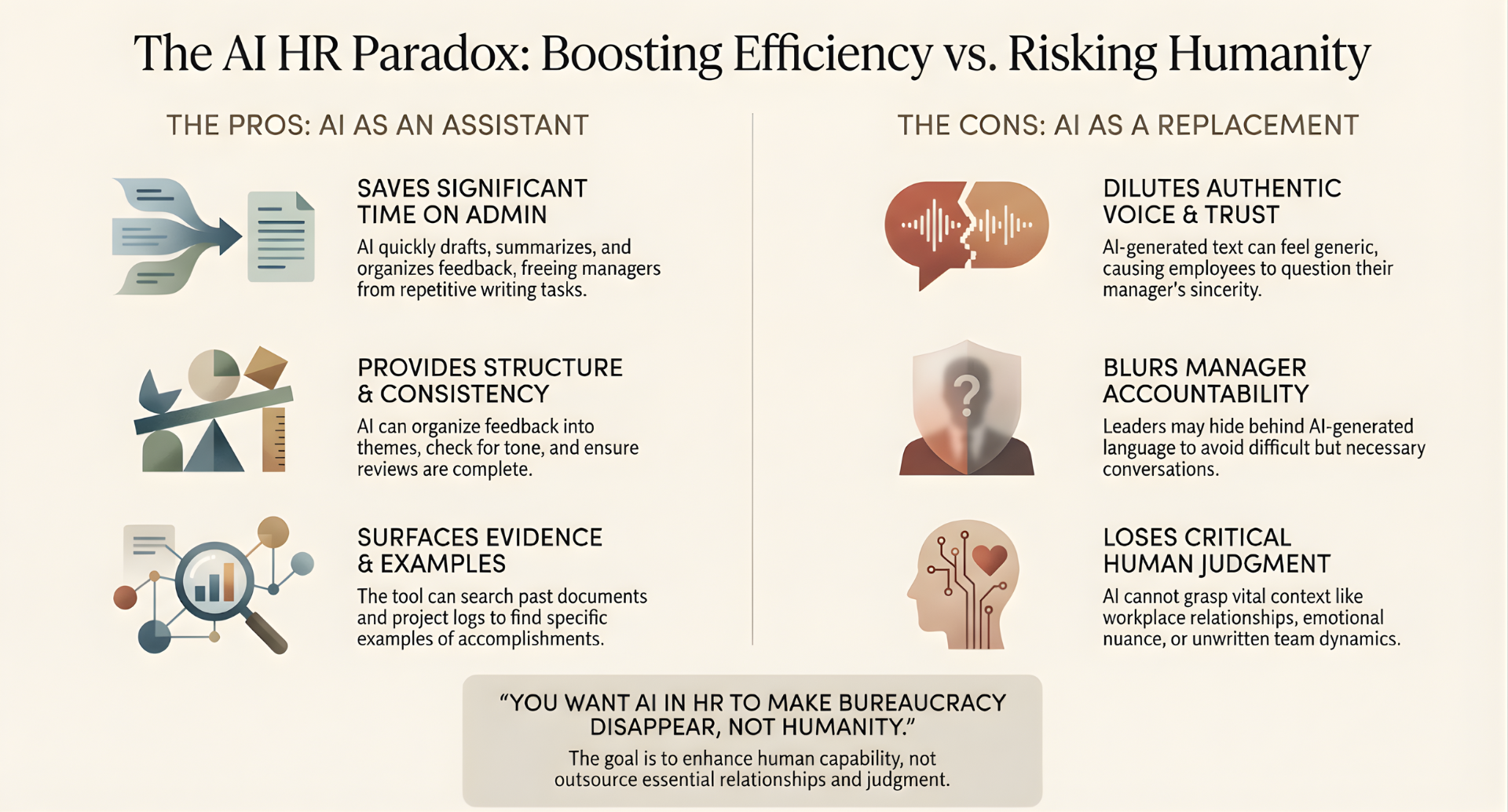
Pros and Cons of Using an Internal AI Chatbot for Performance Reviews
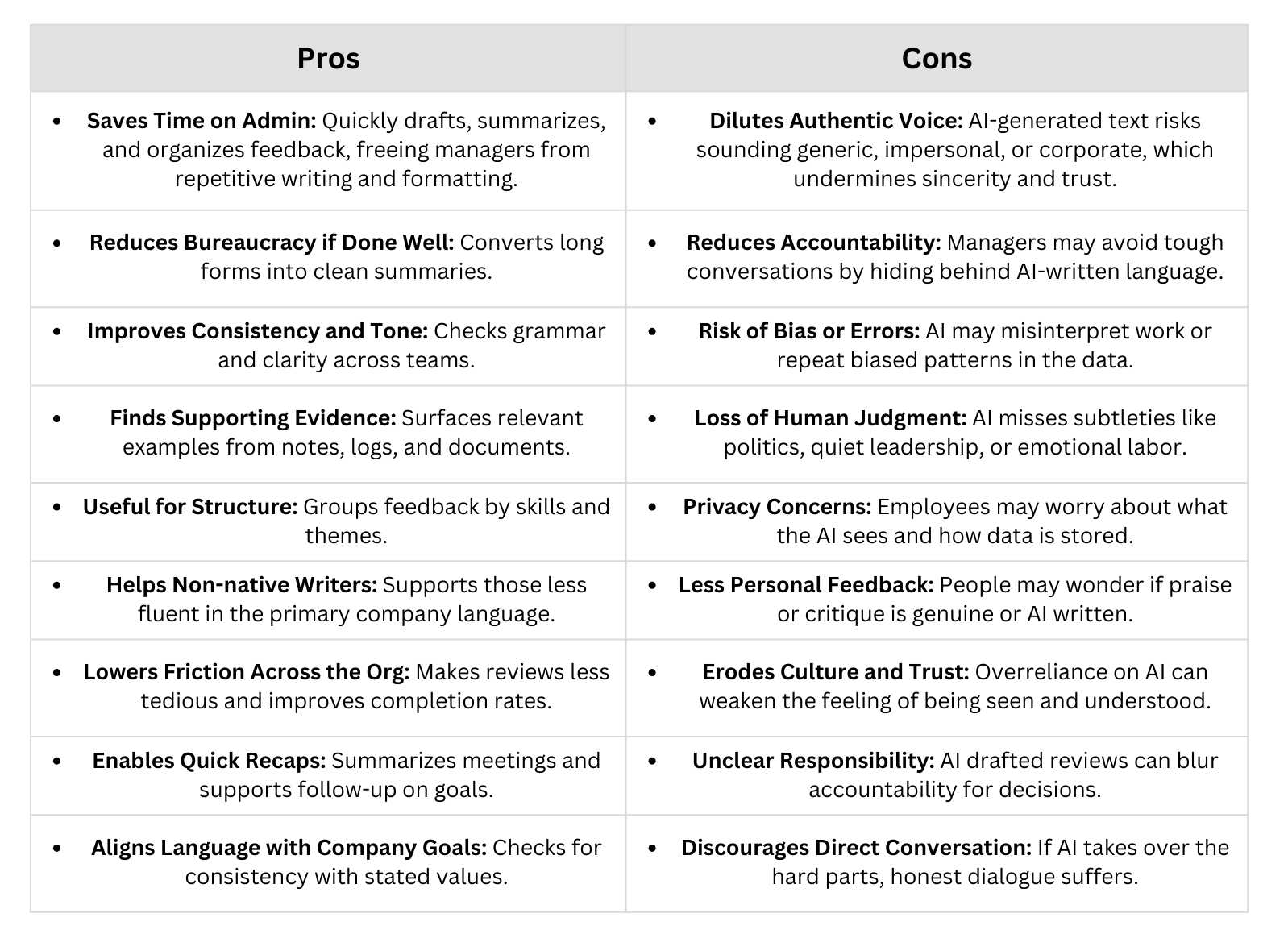
Bottom line: AI should clear the paperwork, not replace the people.
When used wisely, AI can create real value. When misused, it becomes a shortcut that undermines culture.
The Real Goal Is To Amplify Human Value, Not Replace It
The debate around AI in performance reviews reflects a much bigger shift in the nature of work. We are moving into what many call the autonomous age, a period where AI and automation take over routine tasks, and the skills that rise in value are the ones that only people bring to the table.
Creative thinking, emotional intelligence, nuanced judgment, thoughtful coaching, these are becoming more important, not less. The challenge is not how to replace people with AI, but how to build a healthy working partnership between the two.
In the context of performance reviews, the best model is simple. Let AI handle the administrative summaries so managers can focus on the parts that matter. AI does the sorting. Humans do the seeing.
This is how AI becomes a tool that amplifies human capability instead of diminishing it.
A Final Thought
The arrival of tools like Metamate places us at an interesting crossroads. The technology offers real relief from the bureaucratic weight that so many people dislike, yet it also opens the door to decisions that could unintentionally reduce the humanity at the center of work.
The challenge is not to reject the tools. The challenge is to use them with clarity and care. AI should support human conversations, not replace them. It should give leaders more time to be thoughtful, empathetic, and present, not less.
So the question becomes simple. How do we use these powerful systems to increase our productivity without losing our empathy?
That is the work ahead.
If you want, I can also create:
• A shorter newsletter version
• A LinkedIn carousel built from this
• A more Wired/Atlantic editorial voice
• A tagline or CTA for the end
Ryan Edwards, CAMINO5 | Co-Founder
Ryan Edwards is the Co-Founder and Head of Strategy at CAMINO5, a consultancy focused on digital strategy and consumer journey design. With over 25 years of experience across brand, tech, and marketing innovation, he’s led initiatives for Fortune 500s including Oracle, NBCUniversal, Sony, Disney, and Kaiser Permanente.
Ryan’s work spans brand repositioning, AI-integrated workflows, and full-funnel strategy. He helps companies cut through complexity, regain clarity, and build for what’s next.
Connect on LinkedIn: ryanedwards2